The Story of Rahu and Ketu in Vedic Mythology
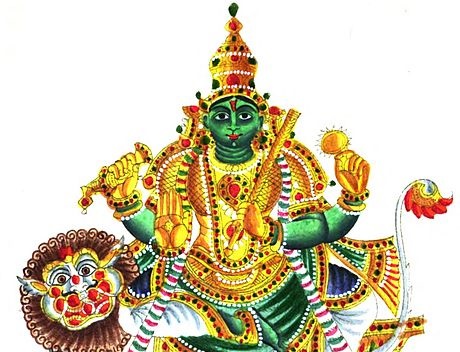
In Vedic mythology, the origin of Rahu and Ketu has a very interesting story that explains why Rahu is considered a head and Ketu a tail, or the lower part of a body.
The myth also tells us the reason why it is bad to have either of them with the Sun or the Moon in an astrological chart, as it explains the origin of their enmity with the luminaries.
Keep reading to find out how the story goes and understand the origin of Rahu and Ketu and their characteristics in Vedic astrology.
The War Between the Gods and the Demons
A long time ago, the gods (devas) and the demons (asuras) were in constant warfare. No matter how many times the gods defeated them, the demons were revived thanks to the powers of their leader, who held the secret of resurrection.
The gods had also possessed the power of resurrection, but they had lost it due to a curse.
Fed up, the gods turned to Lord Vishnu (the God who stands above gods and demons) to ask for help. Vishnu proposed obtaining the elixir of immortality, called amrita, but it was located at the bottom of the ocean of milk.
The Churning of the Ocean
To obtain it, it was necessary to churn the ocean, but this was too difficult a task for the gods alone, so they had to ask the demons for help.
The demons accepted the pact, thinking that once they obtained it, they would find a way to keep the elixir for themselves.
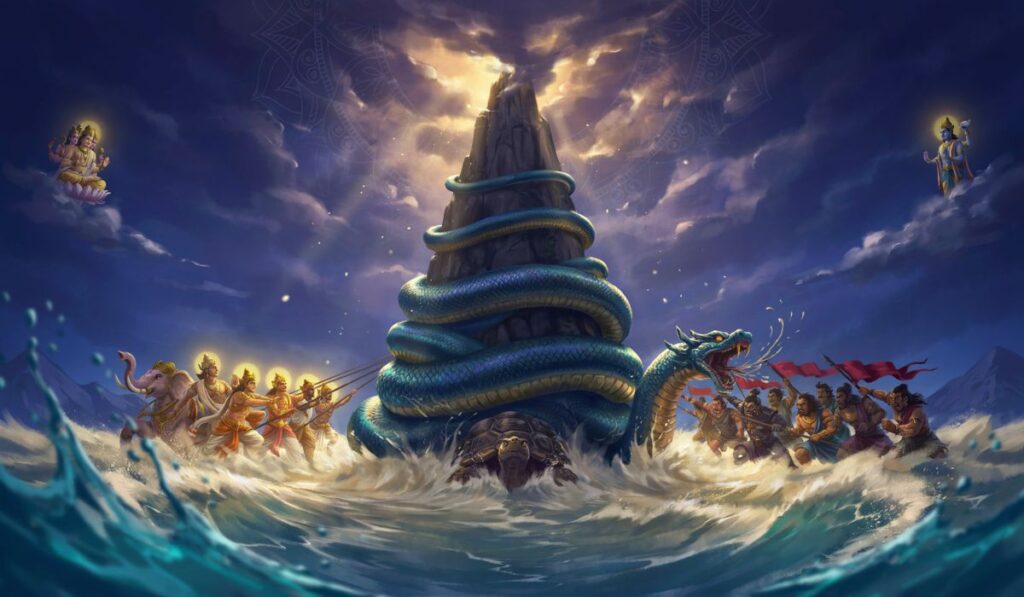
To churn the ocean, they used Mount Mandara and the serpent Vasuki as a rope to wrap around the Mount and turn it, thus churning the ocean.
The work lasted for years. At one point, the Mount began to slip, and Vishnu had to transform into a turtle to go beneath the Mount and support it with his shell.
Gradually, objects and beings began to emerge from the ocean. Among others, the cow of wishes, the tree of wishes, the apsaras (celestial maidens), and tulsi (the sacred plant of India) emerged. Lakshmi also emerged, with whom Vishnu fell enamored and asked to marry. We know Lakshmi as the Goddess of prosperity and fortune.
Mohini and the Distribution of the Elixir of Immortality
Finally, the God of Medicine emerged, holding the amrita in his hand. The demons immediately tried to take it, and conflict with the gods broke out.
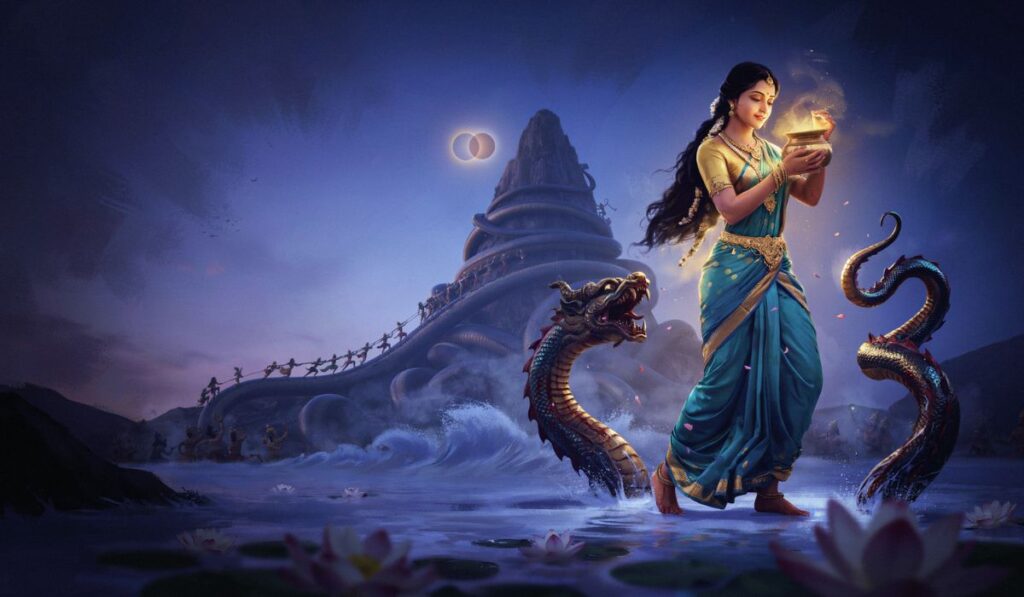
Then Vishnu took the form of an enchanting Goddess, Mohini.
The demons stopped the battle, as they were enchanted by her beauty. The gods were too, although they soon realized that Mohini was actually Vishnu who had come to support them.
Mohini seated the gods on one side and the demons on the other, supposedly to distribute the amrita between both sides. She started with the gods, secretly promising the demons that she would save most of it for them.
One of the demons realized the deception, took the form of a god, and went to sit with them to receive the amrita.
He took a seat between the gods Sun and Moon.
Mohini was distributing the amrita among all the gods, and thus, the demon disguised as a god also drank his portion. As soon as he had taken it, the Sun and the Moon realized he was a demon in disguise, and alerted Vishnu, who immediately cut off his head to try to prevent the amrita from passing down his throat.
Since then, this demon, who had acquired immortality, lives split in two: Rahu (the head) on one side and Ketu (the body) on the other.
And as vengeance against the Sun and the Moon, who had exposed him to Vishnu, Rahu and Ketu (known as the lunar nodes) cyclically “eat” them, thus causing eclipses.
This is why it is negative in a chart to have the Sun and the Moon with Rahu or Ketu, as the influence of the lunar nodes destabilizes them.
If you’re interested in learning more about the lunar nodes, I invite you to read this post about the characteristics of Rahu and Ketu in an astrological chart.
And if you’re interested in knowing how Rahu and Ketu are positioned in your chart, here you can book a session for your astrological chart reading.